
One of the most photographed and painted spots in Amsterdam
Located in one of Amsterdam’s most picturesque spots, Armbrug (Arm bridge) is named after the Oudezijds Armsteeg (Old Side Arm alley).
First published: October 16, 2008
Last updated: Thursday, May 14, 2026
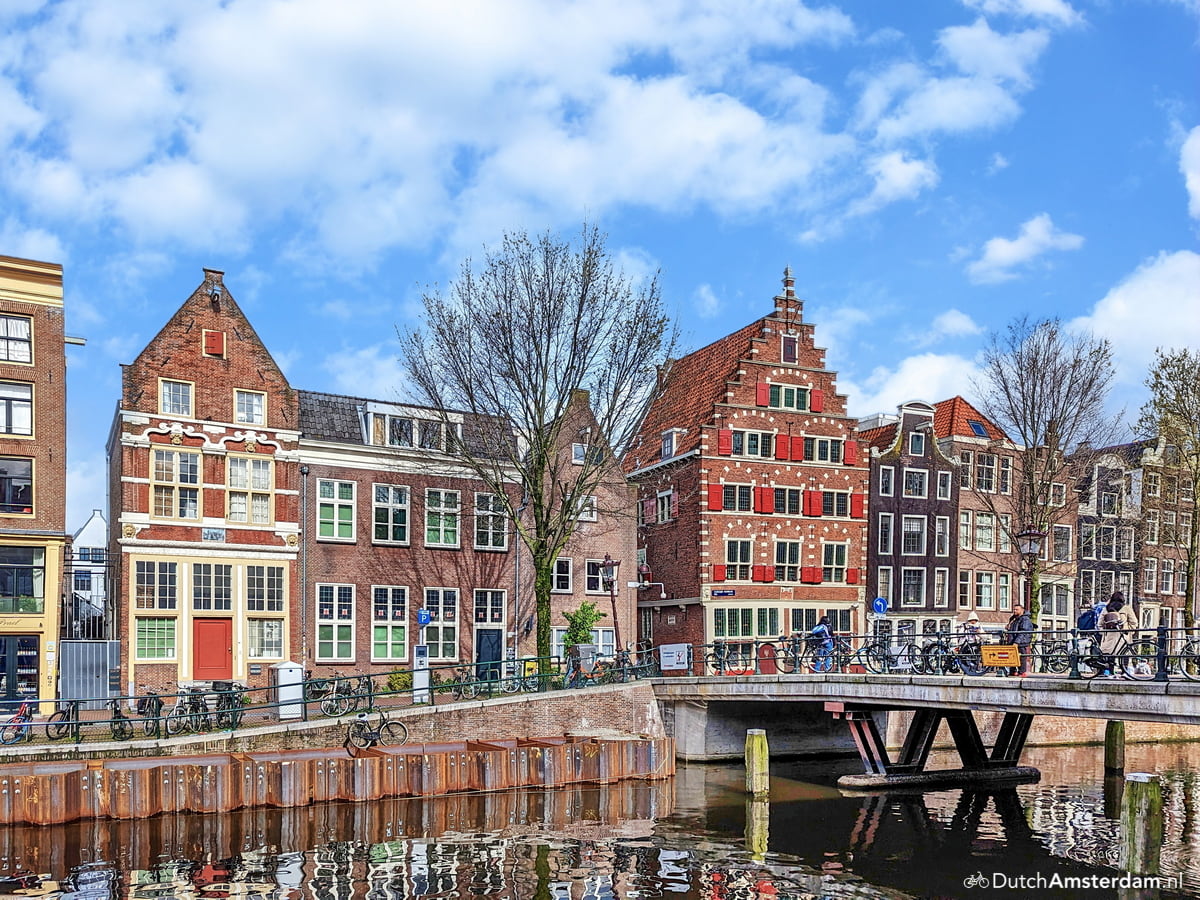
The Armbrug itself is not much to look at. It’s the view from atop the bridge (see below) that counts.
The 1544 map of Amsterdam by Cornelis Anthonisz already show a bridge at this location. But the bridge has been replaced several times in its history. The current concrete model stems from 1988.
‘Arm’ in Dutch can mean poor or, well, arm. In this instance it means the latter, as the alley leads to and from the bend in Warmoesstraat. Yes, to some that looked like a limb
In the distant past the Armbrug was locally referred to as the Provicialenbrug (Provincials bridge). The reason for the nickname was that sketches and paintings of the view from this spot were used to draw provincials (and their money) to Amsterdam.
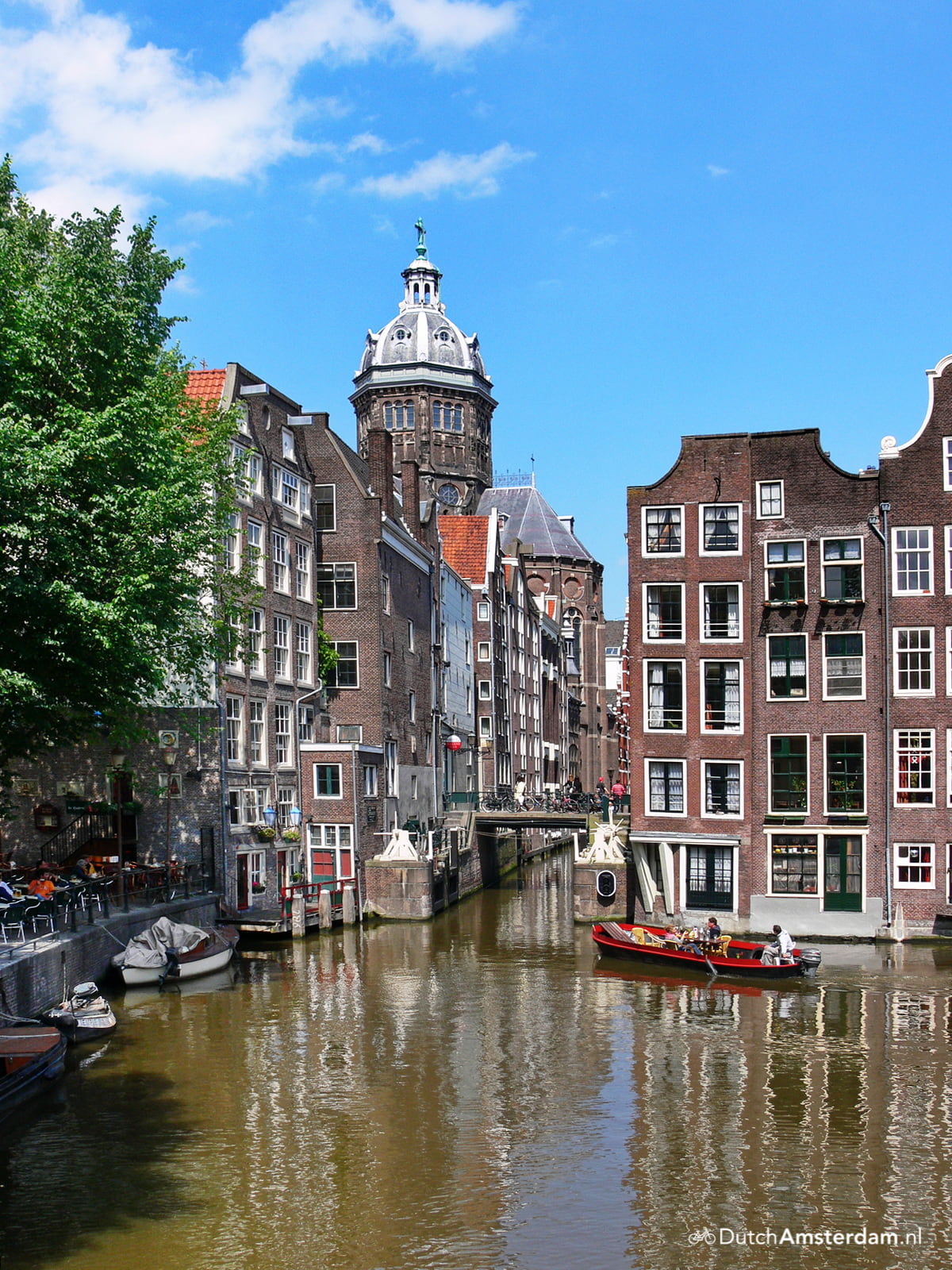
To-date this is still one of the most photographed and painted views in Amsterdam: the Kolksluice leading to the Oudezijds Kolk, and part of the Co-cathedral Basilica of Saint Nicholas (which until December 2012 was known as the St. Nicholas Church).
Amsterdam: Venice of the North
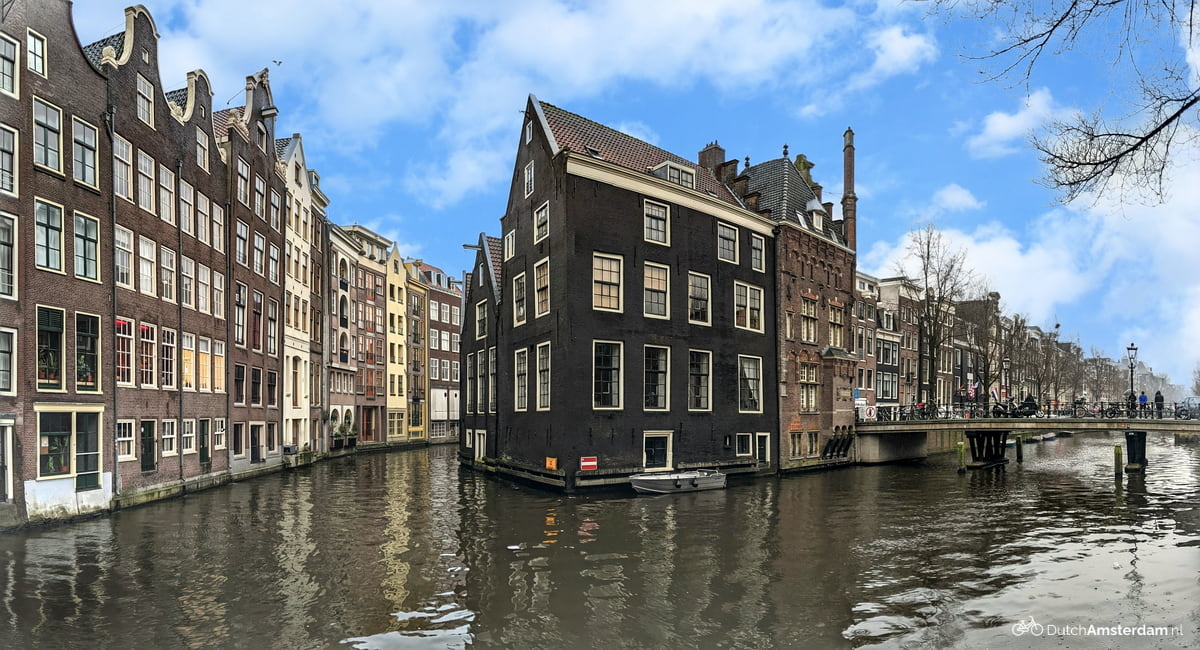
To the left, in front of the sluice, is Cafe-Restaurant De Haven van Texel (The harbor of Texel). From its popular terrace one gets a good impression of why Amsterdam is referred to as the Venice of the North. The backs of the houses at Zeedijk are standing in the water of the Oudezijds Achterburgwal. The canal in front of the terrace is Oudezijds Voorburgwal.
As an aside: The outside wall of the De Haven van Texel is owned by the City of Amsterdam. It displays nine gable stones from demolished houses in this area.
Oudezijds Voorburgwal – Oudezijds Achterburgwal?
This is one of the oldest parts of Amsterdam. These canals were dug between 1342 and 1380 as defensive moats. For a long time, they were lined by defensive embankments – earthen walls fortified with spiked tree trunks.
Even today, Amsterdammers colloquially refer to the Red Light District as De Walletjes – the small walls.
Map: Walking directions to Armbrug
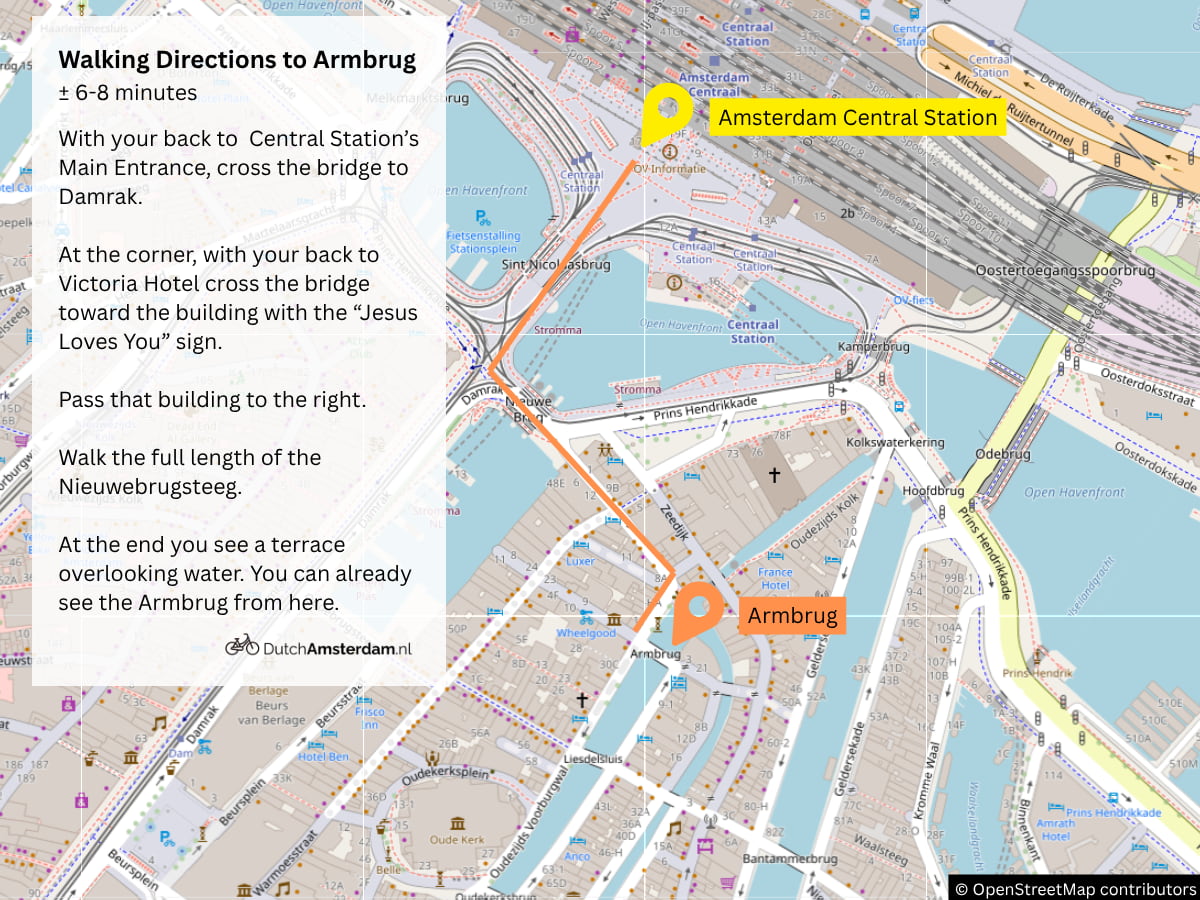
From Amsterdam Central Station you can walk to Armbrug in about 6-8 minutes.
- With your back to Central Station’s main entrance, cross the bridge to Damrak.
- At the corner, with your back to Victoria Hotel cross the bridge toward the building with the “Jesus Loves You” sign.
- Pass that building to the right.
- Walk the full length of the Nieuwebrugsteeg.
- At the end you see a terrace overlooking water.
- You can already see the Armbrug from here.
Before you arrive at the bridge you pass the Major Bosshardt statue. Sitting on a bench, she is looking at the house now named after her. (The house with the red shutters, at Oudezijds Voorburgwal 14).
The Major Bosshardt House
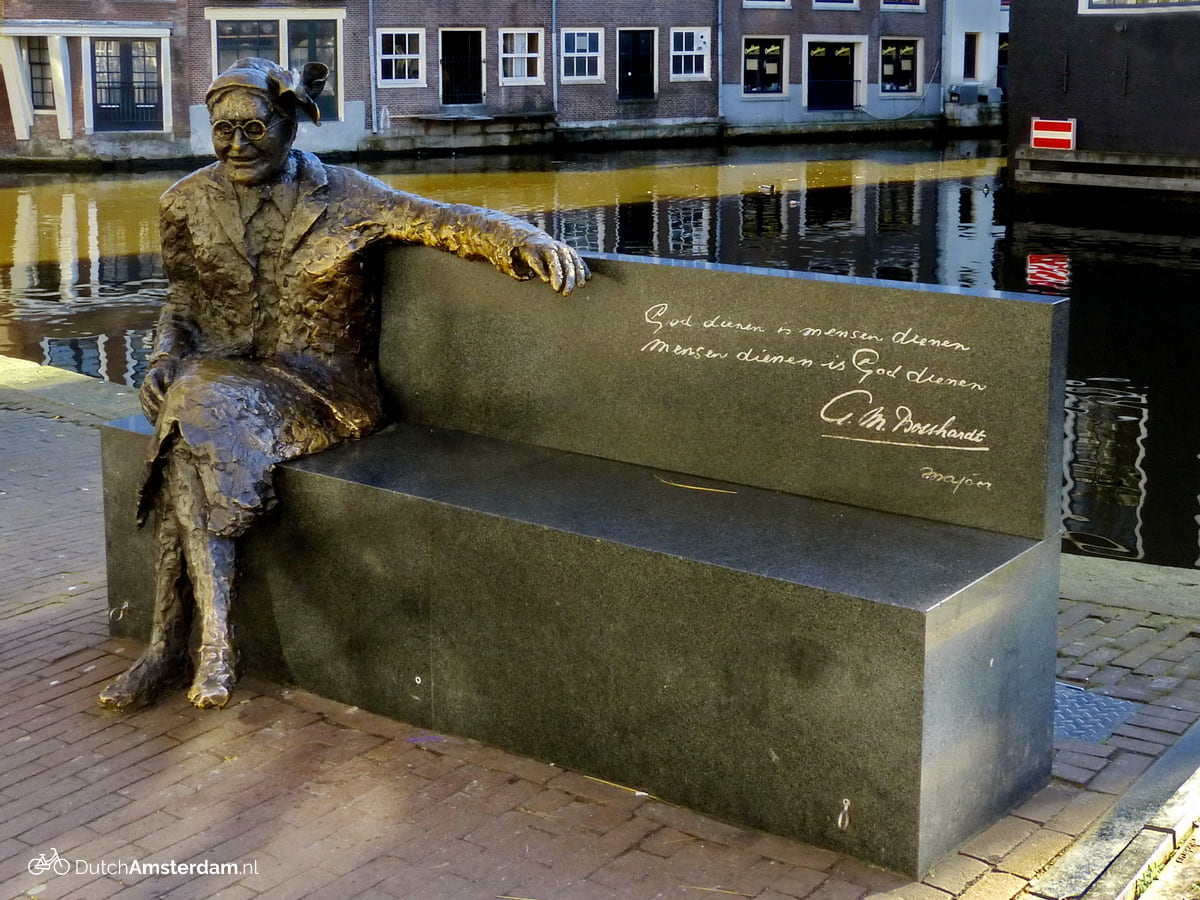
Alida Margaretha Bosshardt, better known as Major Bosshardt, was a well-known and much loved officer in the Salvation Army.
After the Second World War, the Dutch Salvation Army operated its national activities from the building at Oudezijds Voorburgwal 14. This is where Alida Bosshardt worked. Later, in the 60s and 70s, she also lived there.
When she noticed that the Salvation Army had no activities in the nearby Red Light District Alida Bosshardt she brought the matter to the attention of her commander. Soon after, she and a few of her fellow officers started outreach work in the area. They sang and witnessed on bridges and street corners, ‘sold’ the bi-weekly publication “War Cry” in the cafés and pubs, befriended prostitutes, and helped the destitute.
Though Bosshardt officially retired in 1978 she long continued here work. She died in 2007, but even to date most Amsterdammers know her name and reputation.
The inscription on her statue sums up her philosophy: “Serving God is serving people. Serving people is serving God.”
Free Tour: Visit the Major Bosshardt House
You can book a free tour of the Major Bosshardt House, one of the oldest buildings in Amsterdam.
Vredenburgh
The building to the right of the Armbrug is Vredenburgh. It has a history spanning over 500 years. The oldest part dates back to the late 15th century. In 1890 the building underwent a significant renovation and expansion by architect Adrianus Bleijs (the same architect behind the nearby Basilica of Saint Nicholas – the tower of which is seen from the Armbrug)
Originally commissioned by Andries Boelens, an Amsterdam mayor, the building has a history spanning over 500 years. It once housed a brewery, was turned into an inn in the 17th century (“Vredenburgh” – “Fortress of Peace”), and served as an almshouse in the 19th and 20th centuries. The almshouse closed on the final day of 1976. The building fell into the hands of a slumlord, and was eventually taken over by squatters.
In the 1980’s the Municipality of Amsterdam bought the building. After negotiating with the squatters, the building was renovated. Then, under the guidance of what became housing corporation Ymere, the now legalized squatters set up a dance studio, a theater studio, a music studio, two studios for visual artists, and a space used as office space for a theater group.
Red Light District
Technically, this is one of the boundaries of the Red Light District, but you will not notice that. (Read: at this point it is family-friendly).
If you want to avoid the notorious areas, take the alley past Vredenburg to Zeedijk. Or, if it is closed, double back along the canal. Then take the short Sint Olafssteeg at the Haven van Texel to Zeedijk. Turn left to return to Central Station or to Damrak (the street that leads to Dam Square). Or turn right and walk along Zeedijk to Nieuwmarkt.
About those alleys
The Vredenburgersteeg between Oudezijds Voorburgwal and Oudezijds Achterburgwal was long closed off by iron gates and could only be accessed by local renters and homeowners.
Nowadays this alley – and about a dozen others in the area – are again open to the public. Most, but not all, are closed off again in the evening and throughout the night.
Small wonder: tourists and locals alike are advised not to enter the Oudezijds Armsteeg – or any (nearly) empty alley downtown by themselves – as they are ideal places for a quick mugging.
Recommended: Old Amsterdam Walking Tour
Start your journey with the best introduction to Amsterdam: This small group walking tour is top rated.
Walking Tour Highlights
- Explore the heart of Amsterdam on a 2.5-hour walking tour.
- Discover historic landmarks and hidden stories of the city.
- Learn about the Golden Age, Red Light District, and Dutch culture.
- Hear fascinating tales of prostitution, drug policies, and history.
- Gain confidence to explore the city on your own after the tour.
Plan your Amsterdam trip:
- Save on accommodation from hostels and apartments to luxury hotels
- Pick your hotel on this map of Amsterdam and surroundings
- Cheap flights to Amsterdam
- Unlimited Public Transport 1-7 days
- Things to do in Amsterdam
- Key to the City: I Amsterdam City Card (Big Value)
- Visitor’s Guide

Anton and Janet Hein live and work in Amsterdam. We are the publishers of DutchAmsterdam.
Anton was born on a houseboat in the center of Amsterdam, right across from the iconic Westertoren and what later became the Anne Frank House museum. Having lived in nearly every district since then, he knows the city like his own back pocket.
Janet was born in England and raised in Ireland before moving to Amsterdam 42 years ago. Even to date she brings an expat’s perspective to the DutchAmsterdam website.
Last updated Thursday, May 14, 2026 CET (Central European Time)
Do not republish or repost.
