
Amsterdam Metro 52, the Noord/Zuidlijn

Table of contents
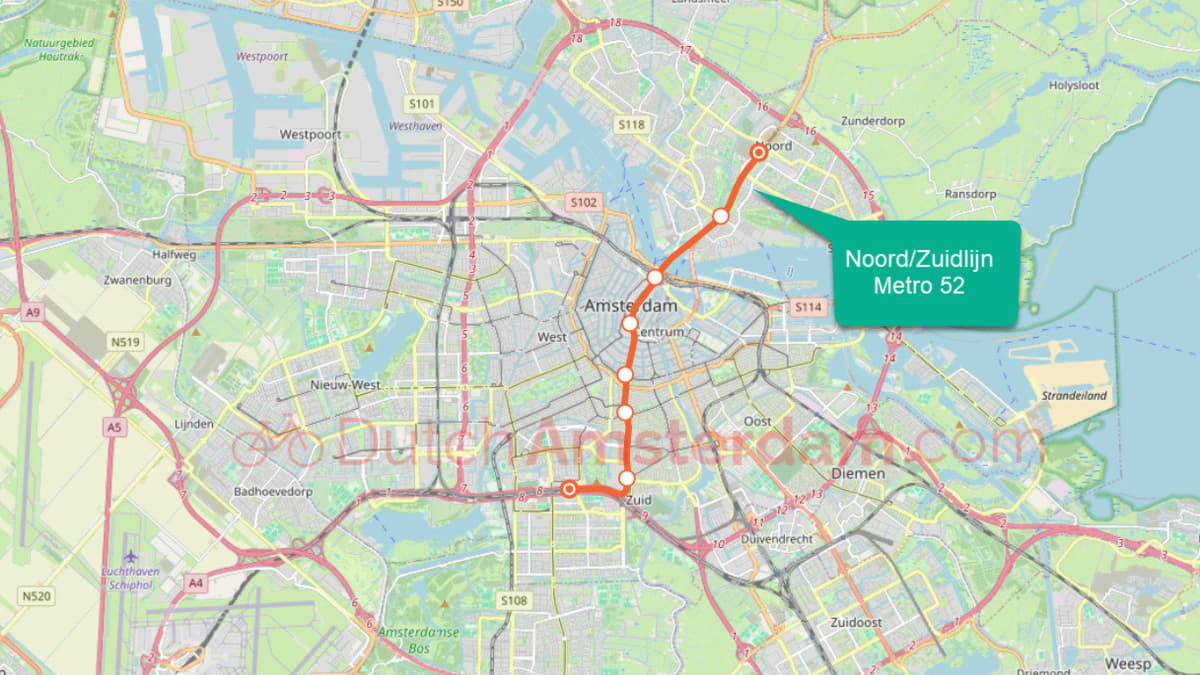
Amsterdam’s long-delayed, problem-plagued North-South metro line — the Noord/Zuidlijn (Metro 52) — officially opened in July, 2018.
People who wish to travel from the Northernmost subway station at the Boven ‘t Y Shopping Center to the Zuidas business district, are now able to do so in 15 minutes.
The journey between the RAI conference center and Amsterdam Central Station takes only 11 minutes.
The Noord/Zuidlijn is only 9,7 kilometers (9.3 miles) long, of which 7,1 kilometers (4.4 miles) underground.
Trains in either direction run every six minutes.
There is talk about extending the line to Amsterdam Airport Schiphol. That makes sense, but such a project includes many complicated issues (including financial headaches). The Ministry of Infrastructure and Water Management says a decision will be made in late 2026.
Maps: Amsterdam Public Transport / Metro
Public Transport Tickets: tram, bus, metro, train & ferry
Need help choosing the right ticket?
Plan your Amsterdam trip:
- Save on accommodation from hostels and apartments to luxury hotels
- Pick your hotel on this map of Amsterdam and surroundings
- Cheap flights to Amsterdam
- Unlimited Public Transport 1-7 days
- Things to do in Amsterdam
- Key to the City: I Amsterdam City Card (Big Value)
- Visitor’s Guide
Metro 52 controversies
Major changes in Amsterdam’s public transport system
The new line, Metro 52, brought a number of drastic, controversial changes to Amsterdam’s fine-mazed public transport network.
The city’s tram and bus network was overhauled to ‘encourage’ travelers to use the Noord/Zuidlijn. The familiar ‘spider web” layout was replaced by a ‘herringbone’ model.
The city’s public transport operator (GVB) 1The Gemeentelijk Vervoersbedrijf (GVB) is the primary municipal transport service of Amsterdam. It is an independent corporation wholly owned by the city of Amsterdam. All trams and most buses you see in Amsterdam are owned and operated by GVB. admits that many passengers now have to change busses, trams, and metros more frequently to reach their usual destinations. However, the GVB also claims that most people will still reach their destination faster than before.
Meanwhile, many Amsterdammers (including us) believe that we are merely being “forced” to use the new metro line so that the city can “justify” the huge cost overruns of the project.
While the Noord/Zuidlijn may be a mixed blessing for Amsterdammers, tourists are among those who benefit. After all, hotels in Amsterdam Noord — across the river IJ — tend to be a lot less expensive than the ones downtown. Metro line 52 assures that you reach Amsterdam’s city center in no-time.
The North/South metro 52 cost overruns
The Noord/Zuidlijn project, for which planning started in 1996, was originally scheduled to be completed by 2007, at a cost of 681,000,000 million euro (at the time, 1.5 billion guilders).
A series of mistakes and other setbacks — including a faulty tender process, administrative problems, shoddy construction work, and the subsiding of historical monuments in “unstable Amsterdam” — has repeatedly led to later opening dates and skyrocketing costs.
By the time the new subway line officially opened, in July 2018, the costs exceeded 3.1 billion euro. That works out to some 3500 euro per Amsterdammer.
After a series of setbacks, in June 2009 a special committee concluded that the project should go ahead as planned, as stopping it would cost more than finishing it.
A second committee in December, 2009, slammed the City of Amsterdam saying that the municipality should never have approved the project.
Forecasted number of North-South line Metro 52 passengers not met
When the city of Amsterdam asked the federal government in The Hague for financial support for the construction of the new metro line, it optimistically forecasted that the Noord/Zuidlijn would be used by 200,000 passengers per day. This figure helped to secure the financial support.
Later the forecast was adjusted several times, and at one point the municipality expected that 121.000 passengers would use the new subway line. That is 39.5% fewer passengers than initially suggested.
Guido Bruggeman, an independent urban transport consultant, believed even fewer passengers would actually use the Noord/Zuidlijn. His prediction bore out. In July 2023, five years after the line opened, GVB reported that on average, 107,000 passengers travel on the North/South line per working day. That works out to 46.5% fewer passengers than stated in the original forecasts.
Bruggeman also claimed that the bus and tram network in Amsterdam was being trimmed to prevent the costly North/South line from having too few passengers. Todate, many Amsterdammers still believe that to be the case.
Amsterdam’s public transport system: from Spiderweb to Fishbone
As mentioned, the old ‘spiderweb’ network of trams and buses was transformed into a ‘fishbone’ model instead. In this situation, the ‘bones’ (the bus and tramlines) feed the ‘backbone’ (the new metro line). The changeover took place on July 22, 2018.
The GVB tried to put a good face on it. Admitting that most people would have to make more transfers in order to go from A to B, it claimed that they will get to their destination faster overall. Anecdotal evidence (including from us, the editors of DutchAmsterdam) shows that this is true for some people and not for others.
In our case, some journeys are noticeably faster, while travelling to other destinations takes much longer than before. For one thing, transfer connections cause additional waiting times. This is perhaps no coincidence, because in the Dutch public transport system, extra travel time also means extra charges.
Writer/Director S.G. Collins puts into words what many Amsterdammers still think about the change:

Amsterdam Airport Schiphol metro extension?
There is talk (isn’t there always) of extending the metro line to Amsterdam Airport Schiphol. That’s a no-brainer, but there is quite a bit of money involved — and the Noord-Zuidlijn has already cost an arm and a leg.
The project includes also includes many complicated issues. The Ministry of Infrastructure and Water Management says a decision is forthcoming toward the end of 2026.
A direct metro connection to the airport would get passengers and local office workers back and forth more efficiently. Many passengers who currently travel to and from by train would switch to the metro. By subsequently reducing the number of slow trains (which stop at every station), space is available for international high-speed trains at the airport’s cramped underground train station.
Schiphol CEO Dick Benschop says, “It is no longer a question of if the metro line should be extended, but when.”
We’ll see. Meanwhile your best options for traveling between Amsterdam Airport Schiphol and Amsterdam are listed here.
Discover more of Amsterdam




Footnotes
- 1The Gemeentelijk Vervoersbedrijf (GVB) is the primary municipal transport service of Amsterdam. It is an independent corporation wholly owned by the city of Amsterdam. All trams and most buses you see in Amsterdam are owned and operated by GVB. ↩︎

Anton and Janet Hein live and work in Amsterdam. We are the publishers of DutchAmsterdam.
Anton was born on a houseboat in the center of Amsterdam, right across from the iconic Westertoren and what later became the Anne Frank House museum. Having lived in nearly every district since then, he knows the city like his own back pocket.
Janet was born in England and raised in Ireland before moving to Amsterdam 43 years ago. Even to date she brings an expat’s perspective to the DutchAmsterdam website.
Last updated Wednesday, April 1, 2026 CET (Central European Time)
Do not republish or repost.
